
Summary
- GE Aviation's revenue, earnings, and cash flow have plummeted in 2020 due to the COVID-19 pandemic.
- Engine makers like GE Aviation generate most of their profit and cash flow from aftermarket services, not selling the engines themselves.
- Most of the engines delivered during the production boom of the past decade haven't even started generating service revenue.
- Aircraft utilization will return to normal over the next 2-3 years, driving a quick return to growth for GE Aviation's services business.
- GE Aviation annual free cash flow could still reach $6-$7 billion by mid-decade.
The COVID-19 pandemic has negatively impacted most parts of General Electric's (GE) business, but none more than GE Aviation. Air travel demand came crashing to a halt as the pandemic spread around the globe in the first quarter. While a few markets (mainly China) have recovered, aviation activity remains extremely weak on a global basis.
Through the first nine months of 2020, GE Aviation's revenue fell 32% year over year to $16.2 billion and segment profit plummeted 86% to $681 million. The segment reported an even steeper 41% year-to-date drop in orders (from $26.1 billion to $15.3 billion). Furthermore, the International Air Transport Association (IATA) doesn't expect a full recovery in air travel until 2024.
As a result, many investors appear to see GE's heavy exposure to aviation as a weakness. That's a mistake. It may take several years for GE Aviation to recover fully from this unprecedented downturn, but the business is still on track for a return to solid growth in revenue, earnings, and free cash flow over the next 5-10 years.
Products vs. services
Last year, GE Aviation generated a record $32.9 billion of revenue. The vast majority of that revenue ($24.2 billion) came from its commercial engines business. Within the commercial business, though, only $9 billion of revenue came from engine sales, compared to $15.2 billion from services.
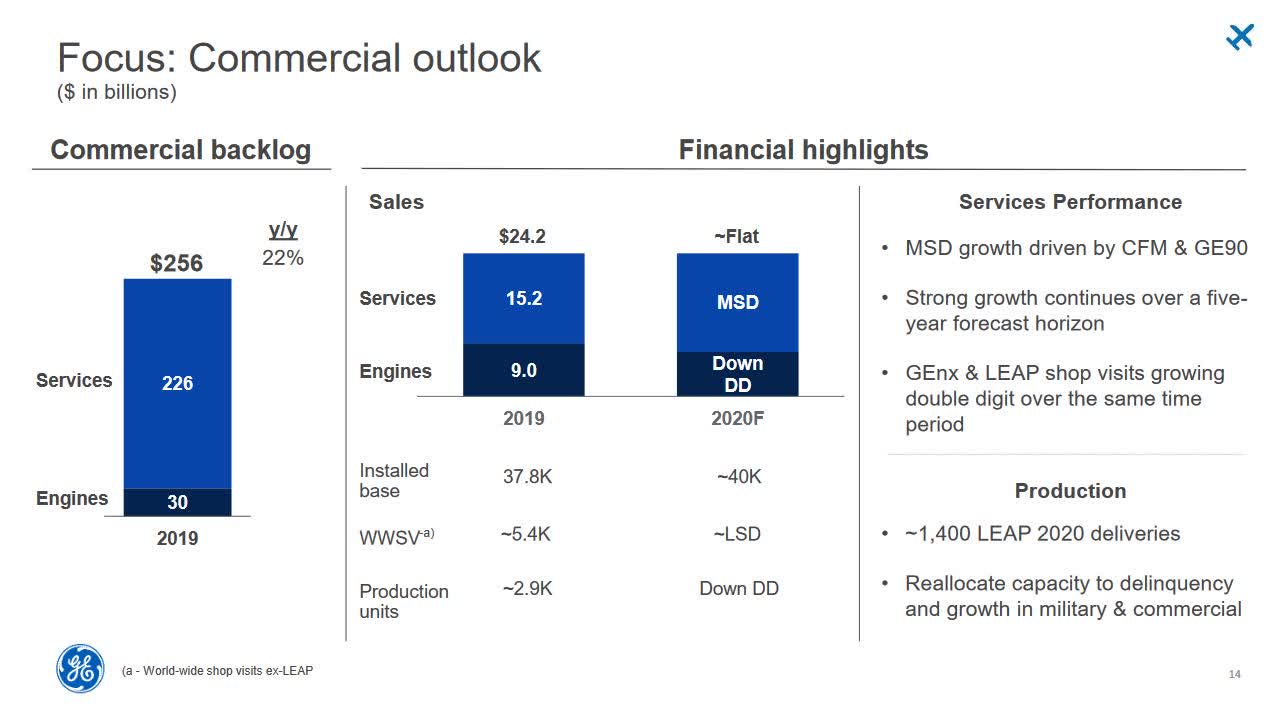 (Source: 2020 GE Investor Outlook Presentation, slide 14)
Moreover, GE and other engine makers typically sell commercial engines to OEMs like Boeing (BA) and Airbus (OTCPK:EADSY) at or below cost. They make their money by selling spare engines to airlines and leasing firms, selling spare parts to third-party MRO (maintenance, repair, and overhaul) shops, and servicing engines through their own MRO shops, both on a one-off basis and through long-term service agreements. Services are the main profit driver, and an incredibly lucrative one at that.

