
Summary
- Berkshire Hathaway has an impressive portfolio of assets generating strong operating cash flow and impressive investments.
- The company has 2% quarterly buybacks moving towards 8% annualized. The company can comfortably afford this and utilize Apple level returns.
- If this is the sign of a new normal, this highlights how Berkshire Hathaway can generate valuable shareholder rewards.
- I do much more than just articles at The Energy Forum: Members get access to model portfolios, regular updates, a chat room, and more. Get started today »
Berkshire Hathaway (NYSE: BRK.A) (NYSE: BRK.B), or Warren Buffett's brainchild, remains one of the largest publicly traded companies worldwide. The company's market capitalization has recovered well since its COVID-19 lows, as its valuation has pushed towards the half a trillion dollar market. With the most recent quarterly earnings, Berkshire Hathaway posted record quarterly share buybacks of $9 billion or ~2% of the float.
As we'll see throughout this article, continued buybacks from Berkshire Hathaway have the potential to generate significant shareholder rewards. Just like Apple (NASDAQ: AAPL), which generated a decade of outperformance through buying back shares with its massive cash pile, we see Berkshire Hathaway as being on track to do the same thing.

Berkshire Hathaway - Wall Street Journal
Berkshire Hathaway 3Q Results
Berkshire Hathaway reported respectable 3Q results, although the company has been clearly affected by the pandemic.
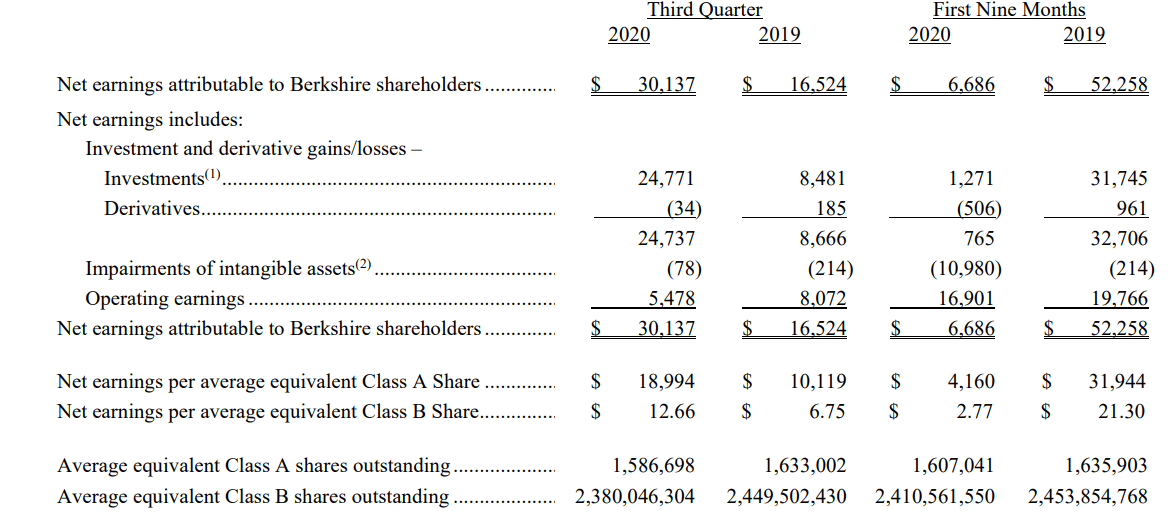
Berkshire Hathaway 3Q Results - Berkshire Hathaway
Berkshire Hathaway watched its net earnings increase significantly, although that was primarily due to share price movements. However, the company's operating earnings decreased significantly from its core businesses. From 3Q 2019 to 3Q 2020, the company decreased its earnings from more than $8 billion to roughly $5.5 billion, a 30% drop.
However, spreading this out over the first 9 months of 2020 versus 2019, you go from $19.8 billion to $16.9 billion, a near 15% drop in 9 month earnings. Over the past year, the company cut its net shares outstanding roughly 3%, although its quarterly buybacks was nearly 2%. The company's continued operational struggles due to COVID-19 shows a strong business.
Specifically, the company's first 9 months annualized earnings would total $22.5 billion giving the company an operating earning P/E of roughly 22. Based on 2019 earnings, it would be less than 19.

