
Summary
- Biogen has embraced Ionis antisense technology for neurology targets.
- A new Gene Therapy Accelerator Unit was formed last year and has facilitated the creation of new business units and collaborations in 2020.
- The stock has been in a holding pattern for six years. Once pipeline progress is apparent, the upside opportunity is substantial.
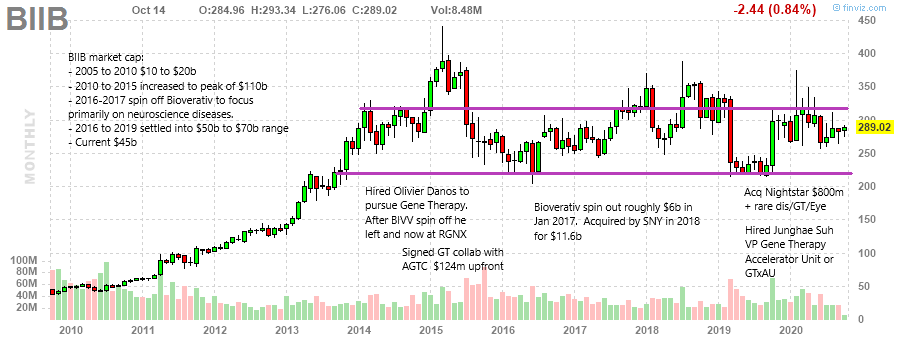
Finviz Chart w/author annotations
The name says it all.
Almost a decade after dipping their toe in gene therapy, Biogen (NASDAQ:BIIB) created a focused internal team called the Gene Therapy Accelerated Unit or GTxAU.
What began with the modest infusion of $29 million into Ionis (IONS) in January 2012, partnering a Phase II clinical program, has morphed into a fully committed embrace of gene therapy. This article will detail how slowing revenue growth led to a six-year trading range which Biogen used to refocus and pivot to genomic medicine - hopefully altering the seemingly endless list of failed trials in the field of neurology.
Revenue: Slow Growth = No Gains
Biogen stock has mostly remained in a trading range since early 2014. Their Multiple Sclerosis or MS franchise, which peaked at 80% of total revenues, reported $8.5 billion in 2019 dropping $300 million from 2016. Biogen spun out their hemophilia franchise in 2017, which erased another $850 million of 2016 revenues. Biosimilars have contributed modestly offsetting some of the declines. The anti-CD20 monoclonal antibody or mAb collaboration with Roche (OTCQX:RHHBY) has continued to ramp, offsetting the rest. Total revenues increased $2.9 billion between 2016 and 2019 from Spinraza, the first commercially approved product for Spinal Muscular Atrophy or SMA.
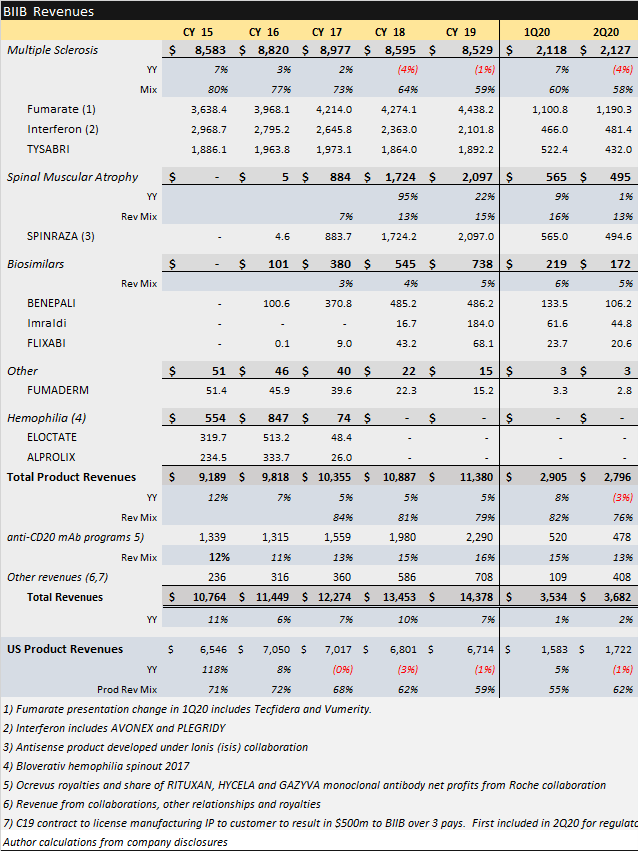
Spinraza was not only the first FDA approved product for the treatment of SMA, it is the first blockbuster gene therapy and remains its largest commercial success. But, as is apparent in the above table, growth is slowing. Growth in 2Q20 dropped to 1% year over year when forward guidance indicated a similar expectation going forward.

