
Summary
- Revenue from GE's industrial assets fell over 20% Y/Y. The company also reported a sizable operating loss.
- Aviation was expected to be the moat. Its revenue fell over 40% and it experienced an operating loss.
- Global passenger demand may not recover to pre-pandemic levels until 2023. This sounds foreboding Aviation's commercial segment.
- Operating losses and $2 billion of cash burn did not improve GE's ability to service its sizable debt load.
- Sell GE.
Looking for more investing ideas like this one? Get them exclusively at Shocking The Street. Get started today »
 Source: Barron's
I was bearish on General Electric (GE) prior to the knock-on effects of COVID-19. The pandemic has practically brought business activity to a standstill, hurting corporations like GE. The company hived off some of its most-attractive assets when the U.S. economy was demonstrating signs of growth. What happens with GE's remaining industrial assets now that the economy is collapsing? Once the pandemic subsides, there is still no guarantee the economy will be able to sustain long-term growth.
GE had previously defined its core businesses as Power, Renewable Energy and Aviation. Now that Biopharma has been sold, it seems appropriate to analyze Healthcare ex-Biopharma as well. GE's industrial businesses - Power, Renewable Energy, Aviation and Healthcare - reported Q2 revenue of $15.9 billion, down 25% Y/Y.
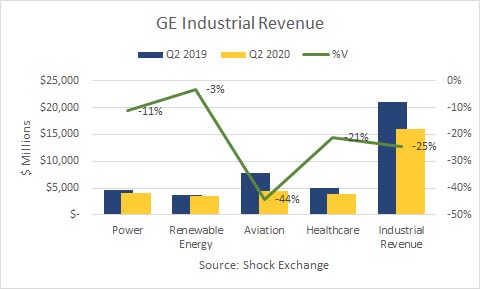 Revenue for Renewable Energy fell in the low single-digit percentage range, while Power, Aviation and Healthcare each fell by double digits.
Power, once thought to be GE's moat, has under-performed for a few years now. It represented 26% of industrial revenue, down from 22% in the year earlier period. Orders were $2.9 billion, down 42% Y/Y. If the global economy does not sustain long-term growth after COVID-19 subsides then governments could continue to cut power generation projects. Renewable Energy revenue fell 3%, driven by onshore wind projects and new turbine deliveries. Orders fell 19% Y/Y as U.S. Onshore orders were delayed due to the knock-on effects of COVID-19.

