
- Warren Buffett is investing in 5 largest Japanese trading houses.
- In this article, I analyze what may have attracted Buffett to these trading houses and Mitsubishi Corp. in particular.
- Valuation, stakes accounted for under the equity method, buybacks, and decent returns on equity could all be factors.
- Looking for a helping hand in the market? Members of Special Situation Report get exclusive ideas and guidance to navigate any climate. Get started today »
Warren Buffett has pulled the trigger on $6 billion of investments into Japan's five biggest trading houses. The FT described them as "century-old commodity specialists that are increasingly transforming into global venture capital and private equity businesses".
Berkshire Hathaway (BRK.A) (BRK.B) holds the investments through subsidiary National Indemnity. Berkshire holds 5% stakes in each of the houses: Mitsubishi Corp. (OTCPK:MSBHF), Mitsui & Co. (OTCPK:MITSY), Itochu Corp. (OTCPK:ITOCF), Sumitomo Corp. (OTCPK:SSUMF) and Marubeni Corp. (OTCPK:MARUF).
This is article is one of a series of five where I go over Sogo Shosha. In this article, I'm going to look at Mitsubishi Corporation to ascertain what attracts Buffett to these names. It is the third installment in a series on the Japanese trading houses. You can read the first installment on Mitsui & Co. here, and the second installment on Itoshu Corp. here.
First, let's look at what Mitsubishi does. All the trading houses are basically conglomerates that were historically more geared towards commodity-related activities. But all the houses have been diversifying beyond those industries. Often, they have hundreds or even in excess of a thousand stakes in businesses. Some are considered subsidiaries and are consolidated if the company holds a 50% or larger stake. Stakes between 20% and 50% are accounted for using the equity method.
Mitsubishi Group encompasses 1,700 businesses it owns in part or in full. The company has a market cap of about $37 billion. There are ten segments ranging from Natural Gas, Industrial Materials and Petroleum to Automotive and Food and others. The image below is from its annual report and shows the major stakes of publicly traded shares it could easily sell.
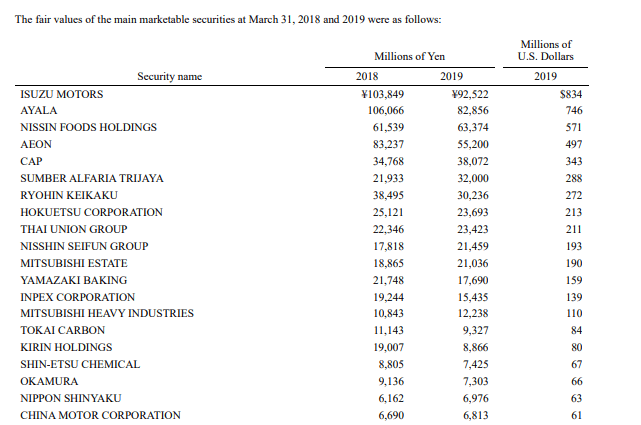
The 2019 value of just these securities looks like it is in excess of $4 billion. It also holds in excess of $12 billion in cash. The below statement is from its latest annual report to give you an idea of the values of the different assets:

