
Summary
- Despite a correlation over recent history, it seems unlikely that Berkshire manages the investment portfolio to match cash and fixed income investments to insurance float, implying substantial excess cash.
- Valuations for the company have swung from having a "Buffett Premium" to a large discount, likely largely because of the huge cash pile and low interest rates.
- Berkshire's discount has widened to 30% of NAV and 40% on the basis of its effective earnings multiple compared to the S&P 500.
- The combination of the company's quality assets, conservative management culture, and valuation continues to make it an ideal portfolio anchor despite the sometimes frustrating pace of investment activity.
Commentary on the pandemic this year has continually reminded me of the story of British Airways Flight 9, which was flying over the Indian Ocean when volcanic ash from Mount Galunggung caused all four engines to fail. Captain Eric Moody, attempting to assuage growing concern, told the passengers:
Ladies and gentlemen, this is your captain speaking. We have a small problem. All four engines have stopped. We are doing our damnedest to get them going again. I trust you are not in too much distress.
The disruption of 2020 has been so great, and the reactions of markets so unexpected, that words almost always fail to adequately capture our present situation. In regards to Berkshire Hathaway (BRK.A) (BRK.B), you will have to forgive me if I also only have understatement to offer you by saying that a lot has happened in 2020.
Berkshire has dumped its investment in airlines, scaled back its ownership in many large financial institutions while rocketing past 10% ownership in Bank of America (BAC), committed to purchasing pipeline assets from Dominion (D), and even now counts a small holding in a gold miner among its investments. Meanwhile, fully half of the equity portfolio is now comprised of Apple (AAPL), with gains this year alone on that one holding exceeding $50 billion.
The global pandemic has been the backdrop for all of this activity, but despite the huge economic shock which has necessitated a $10 billion write-down to the value of Precision Castparts, Berkshire's operating results have remained relatively solid.
I last wrote about the company in March. Berkshire was precisely the kind of company built for the upheavals we have seen this year, and I argued then that the stock was downright cheap, at an underlying price-to-earnings ratio of roughly 11x. Since that time, the stock has produced an extremely satisfying return, albeit one that continues to lag the S&P 500.
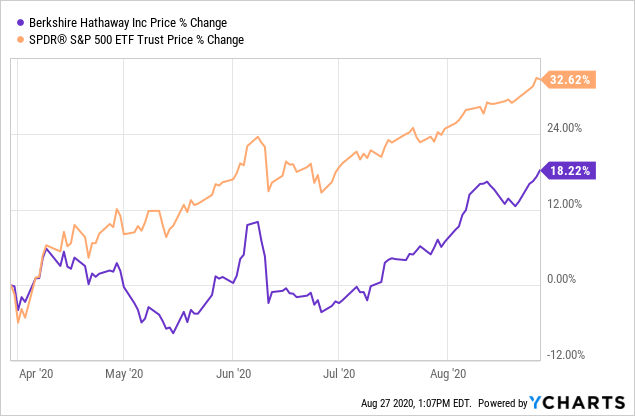 Data by YCharts
In this article, I share some more recent thoughts on the company, divided into three broad sections that tie together. The first section considers Berkshire's cash position relative to the size of its net insurance liabilities in light of some arguments made by a writer I very much admire, The Brooklyn Investor. The second section reviews how Berkshire has historically traded compared to its underlying net-asset-value and discusses both how and why its valuation has shifted from a large premium to a large discount. Finally, the third section updates the modeling of Berkshire's underlying earnings power from earlier in the year and offers some thoughts on forward valuations.
Since the stock has run-up over the previous two months, it's not quite as attractive as it was in the spring, but Berkshire Hathaway remains an ideal portfolio anchor and continues to be compelling at current prices.

