
Summary
- Boston Scientific faces many headwinds in Q3 and Q4 2020 because the pandemic has dramatically curtailed its operations and reduced the demand for its products.
- The company is fairly valued currently, but COVID-19 can deteriorate its financial ratios in the near term.
- Despite headwinds, the company is all set to do well in the long run.
- I do much more than just articles at The Lead-Lag Report: Members get access to model portfolios, regular updates, a chat room, and more. Get started today »
At some point in every person's life, you will need an assisted medical device – whether it's your glasses, your contacts, or as you age and you have a hip replacement or a knee replacement or a pacemaker. The prosthetic generation is all around us. ? Aimee Mullins
All medical device companies are expected to do well in the post-COVID-19 era and Boston Scientific (BSX) is no exception. Every country will ensure self-sufficiency in healthcare products, infrastructure, and services, so that another pandemic does not cause the havoc that COVID-19 has.
My long-term view of BSX is positive. However, there are a couple of issues every investor must factor in before rushing in to buy the stock, and these are:
BSX’s Goodwill and Intangibles
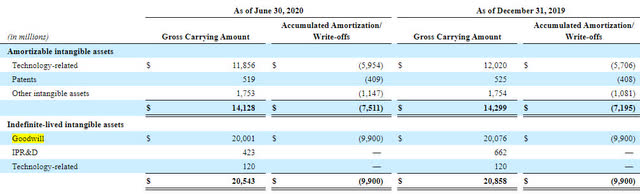
Image Source: BSX SEC Filing
In a balance sheet of $30.8 billion, about $17.2 billion is represented by goodwill and intangible assets. The company carries forward these intangibles from one product generation to the next for each product. It uses a multi-period earnings method to obtain a fair value of its tech-related intangibles, which it amortizes on a straight-line basis over their estimated useful lives.
BSX performs an annual goodwill impairment test in every Q2. In Q2 2020, it found the asset value was more than its carrying value, and hence, no impairment was needed. The company tests its other intangible assets regularly. For example, in Q2 2020, the company booked $34 million in impairment charges on intangible assets.
There’s nothing negative about the company’s goodwill and intangible assets. History tells us that when BSX impaired $2.7 billion worth of intangible assets in the past, its stock jumped 10%. Because such impairments are not a cash charge, smart investors always consider such write-offs as good news despite the negative impact on the profit.
I’ve brought goodwill and intangible assets to your attention because the company has disclosed to the SEC that the value of these assets may be at risk if the pandemic prolongs.

