
Summary
- Rite Aid reported solid Q1 earnings sending the stock up almost 30%.
- COVID-19 has cost them $30M but may also help boost in-store sales as store traffic increases due to being a testing site.
- Rite Aid has broken the 3.5-year down trend.
Rite Aid (NYSE:RAD) has been a stock that has been out of favor for a few years now, as it has fallen 90% since 2017. The company released Q1 earnings June 25, and the stock rocketed up almost 30% on the news. To me, this is the official launch of the turnaround. The stock has been stuck in an ugly downtrend for 3.5-years and has finally broken it. COVID-19 has cost the company millions, but it has also helped drive traffic to their stores in these uncertain times due to being a testing site. As the second wave starts to move across America, testing is going to increase, which should continue to drive traffic into stores as the company strives to become profitable again over the next few years.
(Source: Google)
How Were The Earnings?
The stock didn't explode almost 30% just because it was a sunny day (at least where I was). The stock exploded on the earnings release Thursday morning. They are nowhere near out of the woods, but this was a good start to a potential turnaround story. Some of the highlights from the earnings call include:
All data from the earnings press release
- Q1 Non-GAAP EPS of -$0.04 beats by $0.34
- Revenue of $6.03B, a beat by $420M. Up over 12% year over year. Strong growth in both Retail Pharmacy and Pharmacy Services Segments
- Q1 Adjusted EBITDA from Continuing Operations of $107.4M, compared to $110.3M a year ago
- COVID-19 had a $30M net negative impact on Q1 Adjusted EBITDA
- They saw a net loss of $72.7M. That's a 26.8% year-over-year improvement
- Expects to generate positive free cash flow in 2021
Even though the company saw a $30M negative impact because of COVID-19, there is no doubt the panic-buying of toilet paper, general cleaning products, sanitizers, and wipes helped carry the growth in revenue. Now, don't be fooled, Rite Aid isn't going to turn into a growth monster by any means. It is what it is, a retail drug store. But, as you can see below, after falling off a cliff in 2017, there appears to be some stabilization. As long as they can continue to grow revenue, the stock price should follow.
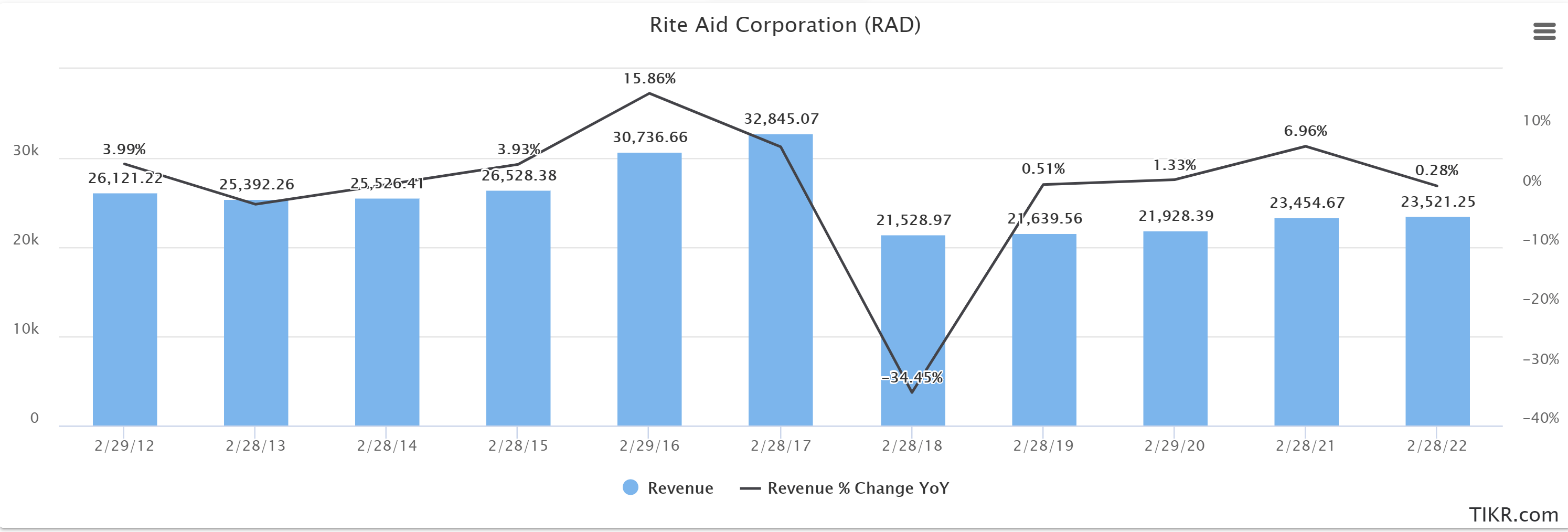
(Source: TIKR.com)
The real "growth" over the next few years should be in earnings as the company tracks down profitability. The company has a very volatile history when it comes to earnings. This isn't something shareholders like to see. Pair that with negative earnings and you can see why the stock is down almost 90% since 2017. What is encouraging is the trend that we are seeing and analysts are predicting. If the earnings can get back to positive numbers in 2022 or 2023, this would be very good news.

