
Summary
- Thinking of Berkshire as a long-term investment, I see three main hurdles that entail a high probability of impeding future growth.
- First, BRK is significantly exposed to the financials, which are facing severe headwinds in the form of technological disruption, the potential risk of "Japanification" and the consequences of COVID-19.
- Second, BRK carries a notable single-stock concentration risk with AAPL constituting ca. 20% of the total market cap. This has the potential to lower the risk-adjusted returns.
- Third, 25% of BRK's market cap is attributable to low-yielding investments that make it way harder for it to deliver on any absolute return target.
Before I jump into the details, I would like to stress that the main purpose of this article is to provoke a thoughtful discussion on Berkshire Hathaway's (NYSE:BRK.A) (NYSE:BRK.B) return potential by highlighting some of the most obvious (in my opinion) hurdles that it could face going forward.
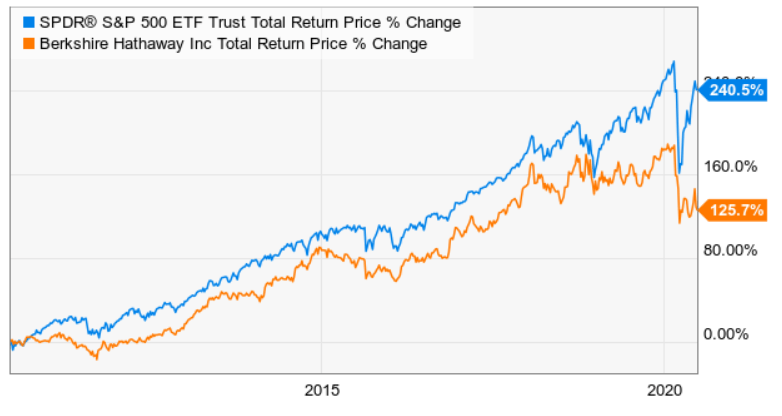
Source: YCharts
In the historical 10-year period, BRK has significantly underperformed the S&P 500 (SPY) lagging behind by more than 100% on a total return basis. Looking at the chart above, it can be noticed that the BRK and SPY have exhibited a rather strong linear relationship and performed more or less in a similar manner.
Yet, since the outbreak of COVID-19, the relationship has broken. Counting from the beginning of May, SPY has really gone ballistic, making up for almost all of the losses incurred earlier in the year. In the meantime, BRK has kept struggling and remained down ca. 20% on a YTD basis. This is despite the ca. $130 billion cash reserve and the commonly accepted notion of BRK being an enhanced version of SPY.
Below I will list three elements, which worry me in BRK as a long-term investment:
1# - Over 35% of equity allocations (10% of total assets) placed in a struggling sector
BRK is heavily exposed to the financials which historically have lagged behind the overall market. As of now, the financials do not entail favorable growth prospects despite the fact that the balance sheets have become much stronger (better capitalized) since the GFC.
Now, I do not argue that the specific names in BRK's portfolio (e.g., WFC and JPM) are worse companies than other peers. My point here is that the sector as a whole is exposed to some serious headwinds which will make it way harder to achieve attractive growth.

