
Summary
- Clothing, furniture, and sporting goods sales were up strongly in May. The recovery in these sub-segments reminded me of TJX Companies.
- The return of risk-seeking behavior is understandable, but I do not feel comfortable being aggressive when volatility remains this high.
- I am cautiously optimistic about TJX's longer-term prospects and believe that the retailer will come out a winner of the COVID-19 crisis.
- Looking for a helping hand in the market? Members of Storm-Resistant Growth get exclusive ideas and guidance to navigate any climate. Get started today »
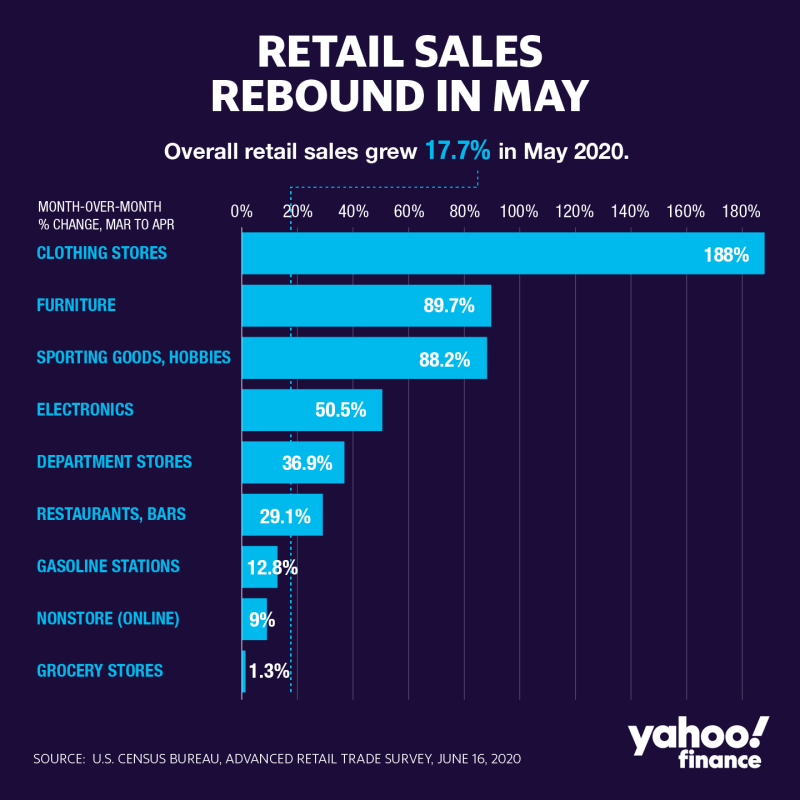
The most recent retail sales report has been the talk of the town so far this week. While consensus expected the recovery in May to take the form of a 5% sequential increase in sales ex-auto and gas, the number came in at over 12% instead. The graph below shows that the largest month-to-month gain happened in the clothing sub-sector, followed by furniture and sporting goods.
This chart reminded me of one of my favorite non-essentials US retailers: TJX Companies (TJX). The company had a brutal first quarter in which revenues were slashed by about half YOY, but I think that the worst days have been left behind. Although COVID-19 will likely leave scars on the retailer's balance sheet for a while, I continue to find TJX one of the best stocks to buy on the heels of a fast recovering sector.
 Credit: Yahoo Finance
The return of risk-on behavior
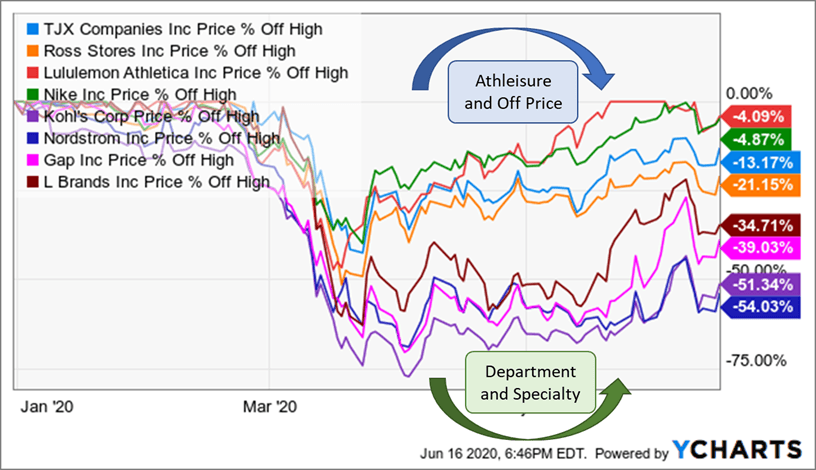
It is understandable that, when the economy shows signs of regaining its footing, risk seeking in the market increases. Therefore, it does not surprise me that stocks like Nordstrom (JWN) and Kohl's (KSS) gained at least 8% on Tuesday alone, while the broad retail sector (XRT) moved less than 3% higher. Both stocks have been up 19% and 42% in the past month, respectively, against the S&P 500's (SPY) 9% climb.
The graph below clearly shows which retail stocks are perceived to be more speculative and which seem to be safer bets. When the rebound from the depths of the coronavirus crisis still looked shaky, athleisure and off-price retail shares came back from the dead much faster than department store and specialty retail stocks, in true V-shaped style. But, by late May, the tables had turned, as investor sentiment improved substantially. Lower quality started to catch up quickly.
Source: graph by YCharts
Not the time for complacency
Despite a general sense of bullishness as of late, I don't believe that now is the time to let go of caution. True, the S&P 500 is only about 7% off its all-time highs. But volatility continues to be abnormally high at these levels, which I interpret as a sign of skepticism.
The chart below may look confusing at first glance, but it delivers a powerful message. Generally, high levels of volatility in the markets are closely associated with deep drawdowns. However, we are living through an abnormal period of close proximity to all-time highs, coupled with high perceived risk - see red marker and arrow below.

