
Summary
- SAM has historically been a quality company, with high returns on invested capital.
- As the company has grown, returns on invested capital have come down.
- Currently, the company has substantial growth prospects ahead. Although future growth in the hard seltzer subcategory will require heavy investment.
- Value analysis shows the stock is crazy expensive at these levels.
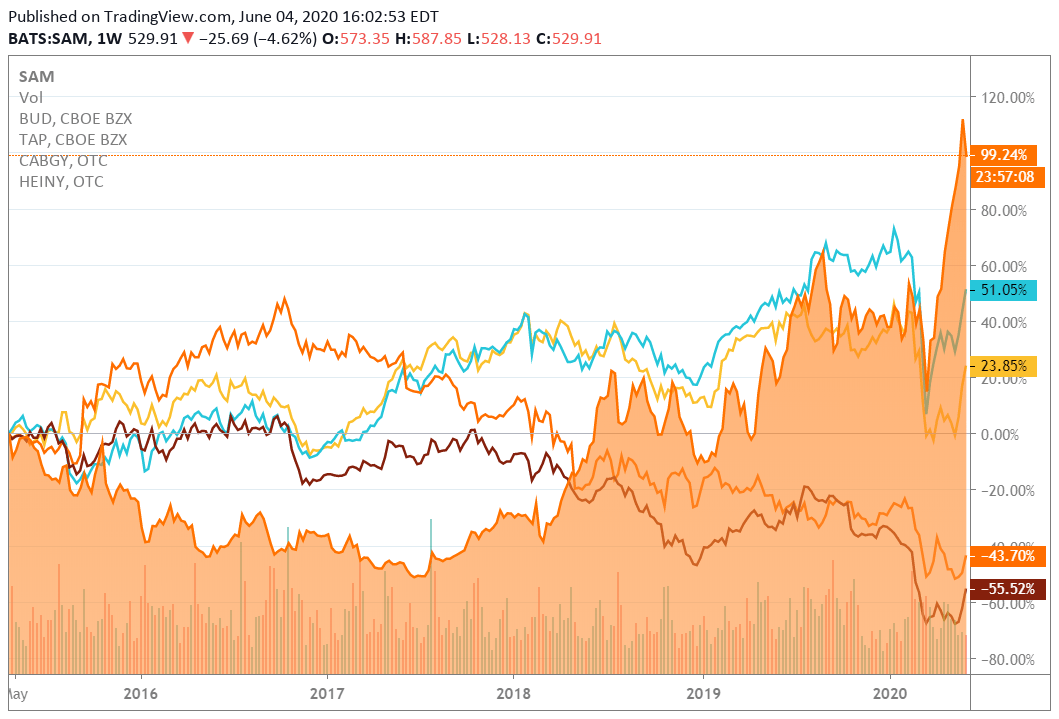
The beer industry is as old as civilization itself, the Sumerian civilization even had a goddess of beer, so it would be fair to classify beer as a mature industry. Given this, what has happened with the stock prices of the major beer producers in the US and the world, operating in this mature industry?
As shown in the graph below, over the latest five-year period, Molson Coors (NYSE:TAP) and Anheuser-Busch InBev (NYSE:BUD) have lost 44% and 56% of their market cap, respectively. Carlsberg (OTCPK:CABGY) and Heineken (OTCQX:HEINY) have gained 51% and 24%, respectively. Meanwhile, Boston Beer (NYSE:SAM) has gained an impressive 99%.
Source: Seeking Alpha
I became intrigued by this outperformance and the trend shifts going on in the beer industry. So I decided to dig a bit deeper in the value case (or lack thereof) for investing in SAM.
Hence, in this article, I will first discuss both the bull and the bear case for SAM. I will then make a value case (primarily focusing on the company's financials) for why the stock is currently overpriced and highlight that investors primarily interested in capital preservation should avoid this stock.
Reason for out-performance
As shown in the graph below, beer consumption (post-prohibition) peaked during the 1980s in the US. In general, the situation for lager beer is even worse, while first fighting the rise of craft beer and now hard seltzer.

Source: ourworldindata
SAM was founded in 1984 and has a decent track record maneuvering these trends, first profiling itself in the craft "better beer" category and during the last few years as one of the strongest brewers in the hard seltzer category.
The growth in the hard seltzer subcategory of the larger beer category has been impressive (to say the least). Certain weeks during the spring, year-over-year weekly sales have shown 300% growth. Due to this, the stock bottomed at $306 per share on March 20, and last Friday close (June 5) was $522.

