
Summary
- General Electric was a bad investment over the last couple of years, and ran into operational problems through 2019.
- In 2020, things got even worse, due to the impact the coronavirus pandemic has on GE's businesses.
- Shares have lagged both the broad market and its peers, and rightfully so.
- If management can successfully turn this ship around, shares could recover a lot of ground. But we believe that it is more prudent to go with higher-quality choices in the industry instead.
- This idea was discussed in more depth with members of my private investing community, Cash Flow Kingdom. Get started today »
Article Thesis
General Electric (GE), which has had more than its fair share of problems during the last couple of years, has run into a range of additional problems caused by the coronavirus pandemic. This includes, but is not limited to, headwinds for its aircraft engine business, which normally is the company's crown jewel.
Shares are not trading at an expensive valuation relative to the revenues that the company generates, but due to General Electric's myriad of problems, going with other industrial names may be the better choice for investors.
 Source: Seeking Alpha's image bank
Core Peer Siemens Was The Better Choice
A couple of months ago, we wrote an article detailing why we believed that Siemens (OTCPK:SIEGY) (OTCPK:SMAWF) was a better pick compared to General Electric. This article was centered around factors such as a stronger balance sheet for Siemens, a more attractive product lineup with more exposure towards higher-growth markets such as Industry 4.0, and a more efficient way of operating the company. Since then, the performance of Siemens and General Electric has been quite different:
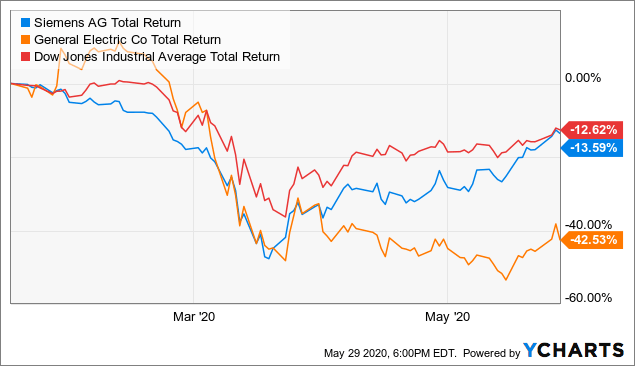 Data by YCharts
Since then, Siemens' shares are down 13%, virtually on par with the Dow Jones Index (DJI) (DIA), while General Electric has generated a total return of -43% in the same time frame. This was not based on a weaker performance during the midst of the market sell-off, where Siemens and GE had dropped more or less the same. Instead, the market's cognition that Siemens was much better positioned to weather the current crisis has allowed Siemens' shares to recover most of the losses during April and May.

