
Summary
- Berkshire Hathaway shares have sunk to the most recent book value figures.
- Shares trading this close to book value is a truly rare event, taking place only on two other brief occasions this century.
- Shares are even more attractive than when this happened previously and offer an attractive buying opportunity.
With Class B shares hitting a low of $167.00 on Wednesday, before finishing slightly higher at $172.44, Berkshire Hathaway (BRK.A) (BRK.B) broke through its most recently available book value numbers. Berkshire shares available this close to book value has taken place only two other times this century - during the Great Recession and a brief dip in share price that took place in 2011.
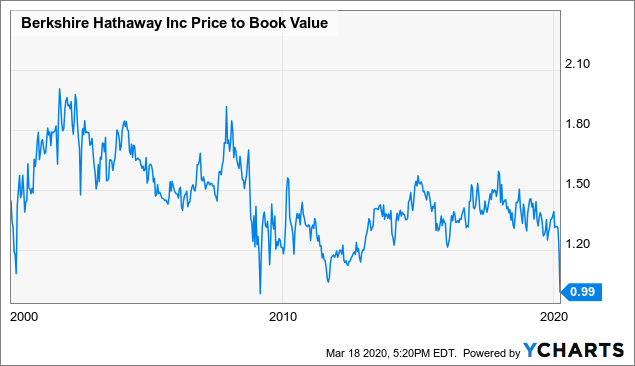 Data by YCharts
For decades, Berkshire Hathaway highlighted book value in the annual report, using it as a proxy for measuring changes in its intrinsic value. This practice was abandoned after 2018. Buffett wrote:
Long-time readers of our annual reports will have spotted the different way in which I opened this letter. For nearly three decades, the initial paragraph featured the percentage change in Berkshire’s per-share book value. It’s now time to abandon that practice. The fact is that the annual change in Berkshire’s book value – which makes its farewell appearance on page 2 – is a metric that has lost the relevance it once had. Three circumstances have made that so. First, Berkshire has gradually morphed from a company whose assets are concentrated in marketable stocks into one whose major value resides in operating businesses. Charlie and I expect that reshaping to continue in an irregular manner. Second, while our equity holdings are valued at market prices, accounting rules require our collection of operating companies to be included in book value at an amount far below their current value, a mismark that has grown in recent years. Third, it is likely that – over time – Berkshire will be a significant repurchaser of its shares, transactions that will take place at prices above book value but below our estimate of intrinsic value. The math of such purchases is simple: Each transaction makes per-share intrinsic value go up, while per-share book value goes down. That combination causes the book-value scorecard to become increasingly out of touch with economic reality.
In other words, over the years, book value increasingly understates the true intrinsic value of Berkshire Hathaway. While operating businesses will have their retained earnings reflected in book value, their growth in market value is not. This is why Buffett has been increasing the level at which shares would be repurchased. First repurchases would only take place at 110% or less of book value. This was then increased to 120%. Eventually this too was amended in favor of repurchases at any price below Berkshire's intrinsic value, conservatively calculated.
Last quarter Berkshire bought back $2.2 billion of its stock, the most ever in a single quarter. This was with Berkshire shares hovering around 130% of book value for the quarter. Currently being able to purchase shares of Berkshire at or near book value, already a rarity, represents a greater bargain than being able to do so previously.

