
Summary
- Syros Pharma has 2 clinical stage drugs under development.
- New collaboration with Global Blood is a plus.
- Mark Alles joining the board is intriguing.
Syros Pharmaceuticals (SYRS) is a small cap, clinical stage pharmaceutical company. As such it carries all the risks and potentials to the category. Mainly, if its drugs fail to gain regulatory approval, it will turn out to be a bad investment. If one or more drugs gain regulatory approval, and that is followed by commercial success, then Syros could turn out to be an extraordinarily good investment.
I last wrote about Syros (Syros Pharmaceuticals Platform Undervalued After Dip) on April 9, 2019, when the stock had closed at $6.82. On January 21, 2020, as I write, the stock is down almost 9% for the day to $7.74, as it comes off a near-term peak of $9.41 that followed positive news to be discussed below. I wish the 21.6% increase between April 9 and January 21 could be attributed to investors agreeing with my earlier article's thesis that Syros was undervalued. But a look at the charts shows it is almost certainly just volatility. The 52-week low is now $4.45, the high $11.93, so we are back to midrange. High volatility is not unusual behavior for a pharma company that may or may not ever generate commercial revenue and that is thinly traded. As I write the market cap is $329 million, but it could be considerably up or down by the time you read this.
Nevertheless, long-term investors like myself do try to predict the long-term future, or at least the odds of success. This article is mainly to provide an update, but the thesis is the same: Syros is undervalued.
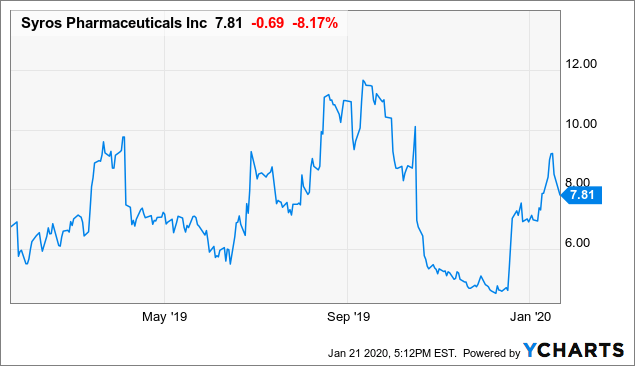 Data by YCharts
Collaboration with Global Blood
On December 18 Syros and Global Blood Therapeutics (GBT) announced a collaboration agreement. Syros will use its gene expression platform (discussed in more detail below) to discover potential therapies for sickle cell disease and beta thalassemia. Global Blood will receive a global option to develop and commercialize the therapies. Syros will receive $20 million cash upfront and three years of preclinical research funding, plus potential milestone payments. In addition, if the drugs ever generate commercial sales, Syros would get a mid to high single digit royalties.
Syros had already completed some investigatory work. Syros already identified components of LRF (leukemia/lymphoma-related factor) and the NuRD (nucleosome remodeling and histone deacetylation) complex that could switch on the gamma globin gene and induce the production of fetal hemoglobin. This could improve the health of the blood in sickle cell or beta thalassemia patients. For investors, the $20 million in cash is of immediate importance, as it extends the cash runway for the development of Syros's drugs currently in clinical trials. Any major payoff for investors from the collaboration would be something like 5 to 10 years away, and program success is speculative. Also note there are competing therapies, including Acceleron's (XLRN) Reblozyl (luspatercept), which was recently approved for beta thalassemia. For me it is an important vote of confidence in the platform concept by a company that has strong expertise in its therapeutic specialty.

