
Summary
- The second quarter results were rather a disappiontment as Tiffany had to report a decline in revenue in all regions and also declining comparable sales.
- But Tiffany has a strong brand derived from the customer perception and the feeling of exclusivity.
- Tiffany should be fairly valued around $84.
- Hermes as well as LVMH are probably better long-term investments than Tiffany.
- Looking for a helping hand in the market? Members of Moats & Long-Term Investing get exclusive ideas and guidance to navigate any climate. Get started today »
One of the companies that is often used by Pat Dorsey in his speeches (for example here; minute 15) as an example for a powerful brand name, which leads to a wide economic moat is Tiffany (TIF).

(Source: Pixabay)
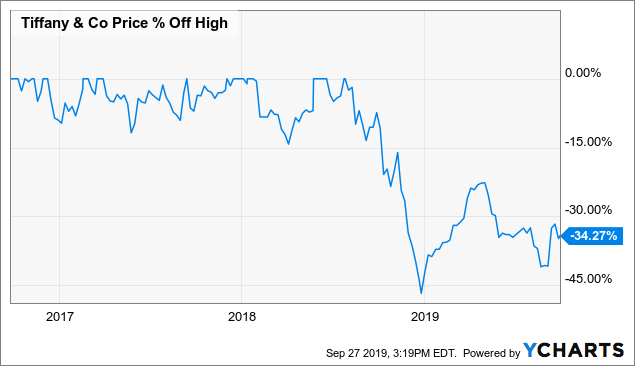
As the stock price dropped almost 50% in late 2018 and is still trading 35% below its former highs, it makes sense to take a closer look at the stock and try to determine if it could be a good long-term investment.
Business Model
The company’s principal product category is jewelry, which represented more than 90% of total sales in each of the last three years. Aside from jewelry, the company also sells watches, home and accessories products as well as fragrances. The biggest part of revenue (44%) is still generated in America, while the Asia-Pacific region is responsible for 28% of total sales. Japan is responsible for 15% of total sales and Europe comes in last with a share of only 11%.
The company is generating most of its revenue by sales from company-operated retail locations. At the end of 2018, Tiffany operated 321 stores and over the last few years, the number of retail locations was growing slowly (with a single digit number of new stores every year). Additionally, the company has licensing agreements, but the earnings received from the licensing agreements represented less than 1% of worldwide sales in 2018. Aside from physical retail locations, Tiffany also operated e-commerce enabled websites in 13 countries (as well as informational websites in several additional countries). Sales transacted on those websites, through catalogs or via telephone accounted for 7% of worldwide net sales in the years 2018, 2017 and 2016.

