
Summary
- I will provide a detailed summary of Markopolos’ strongest claims. Make your own judgments.
- The strongest of his claims revolves around GE’s Employers Reinsurance division, and what he claims are their massive underfunded future liabilities.
- Those coming to the defense of GE have yet to counter any of his strong claims in anything close to a substantive way.
- If no one does so this week, odds are that Markopolos has hit on something real here.
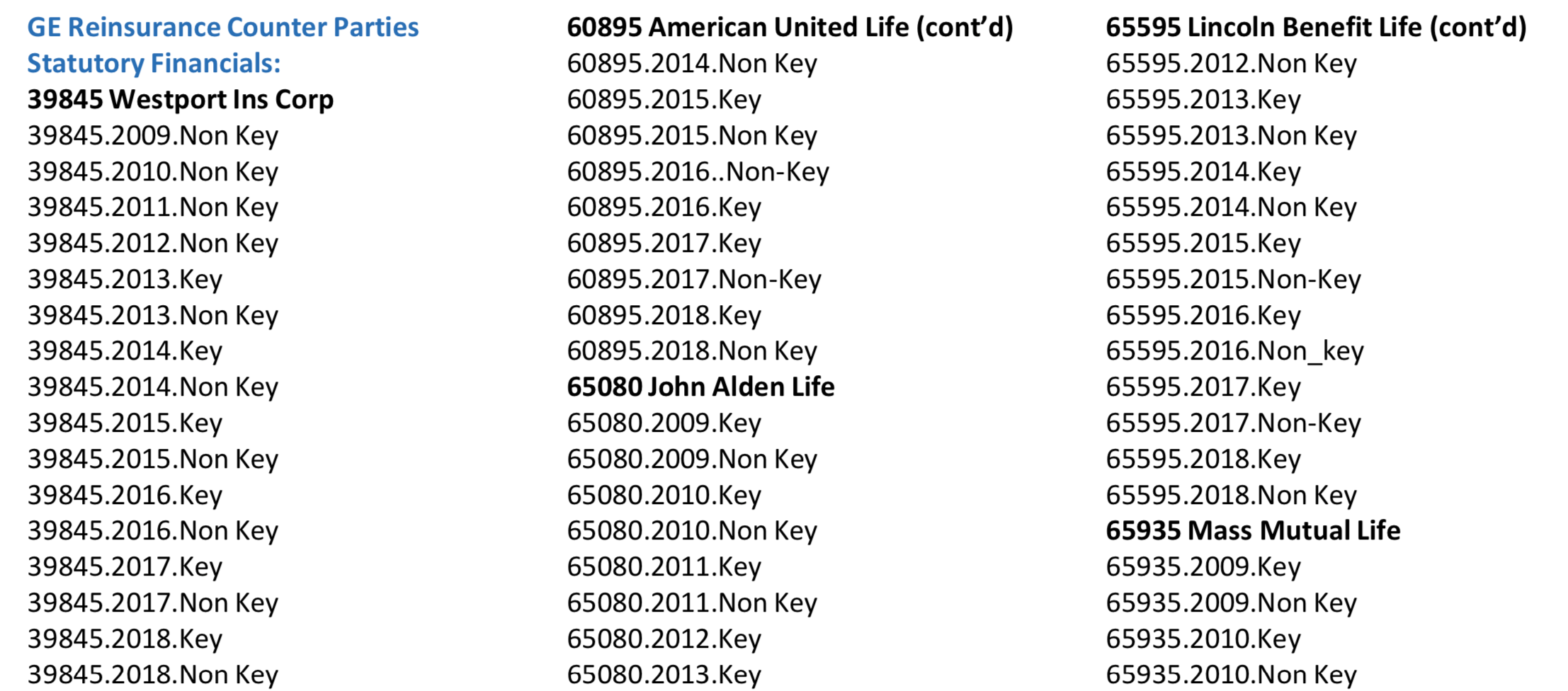
It helps to show your work. Markopolos used over a thousand tables from state insurance commissions.
I Read So You Don’t Have To
Harry Markopolos, most famous for badgering the SEC about Bernie Madoff for years before he was caught, is back again. He has a 169-page report on General Electric (GE), which came out last week, sending the stock tumbling. On Friday, many came to the defense of GE and their CEO, Larry Culp. Along with the surging market, GE's stock recovered, but not completely, and is still down both absolutely and relative to the broader market.
 Data by YCharts
I’ve seen a lot of misunderstanding about what is in the report, much of that is contributed by Culp’s defenders and Markopolos’ own terrible TV appearance. Well, I read so you don’t have to.
To briefly sum up, Markopolos’ strongest claim is regarding GE’s Employers Reinsurance division:
- The portfolio of long-term care (LTC) policies that GE reinsured are the worst of the worst, with the lowest premiums, the highest benefits, and 70% of them lifetime policies with no limits. The loss ratios are staggering and grow hugely every year.
- They had to have known this, at the latest, by 2015, but likely when they let these 7 insurance companies unload their most toxic policies on them.
- They booked the profits from the policies while the policyholders were still young and the policies were still earning, and did not set aside adequate reserves. The money was used for dividends and buybacks instead.
- They still don’t have adequate reserves, if you compare them to Prudential (PRU), which holds similar (though not nearly as bad) policies. They have wildly underfunded reserves, even if they can somehow come up with the $9 billion remaining on their 2017 charge for the Kansas commission.
- They have a huge charge coming in Q1 2021 due to changes in GAAP and they have been kicking it down the road. It is non-cash, but it will wipe out their balance sheet. Prudential took care of this in 2018.
To sum up, GE’s and Culp’s defenders' arguments:
- Culp is a great guy.
- Markopolos is talking his own book.
- Markopolos is being paid by GE shorts.
Notice anything there? They have stood up for Culp’s integrity, and besmirched Markopolos’, but there is, as far as I can tell, no substantive rebuttal to the detailed claims Markopolos makes. In poker, that’s called a tell.
I am not an accountant or attorney, so I will leave the question of fraud open. My own take is that if this stuff isn’t illegal, then that’s the bigger scandal.

