
Summary
- In my previous article on this top, I asserted that a Washington Post exposé on the opioid epidemic was largely irrelevant to the stocks involved.
- That is still my base case, however, a verdict in Oklahoma is due by end of August, prosecutors asking for $17B from J&J for its involvement in the opioid epidemic.
- I believe J&J will win, but if they don't, it opens the door for a speculated $100B master settlement that could bankrupt the companies exposed in the Post.
As I covered earlier this month, the companies implicated in the opioid epidemic in a recent exposé by the Washington Post are in dire straits. My thesis in that article was that any settlement would be symbolic because the companies cannot afford big payouts. Teva (TEVA), McKesson (MCK) and Mallinckrodt (MNK) are not healthy companies and cannot afford multibillion dollar penalties. They may not even be able to survive it at all. But there is a (small) chance that a multibillion dollar settlement will be forced through anyway, and this could even spell the end of the companies above. To protect against this possibility, investors may want to hedge against these stocks declining or even falling to zero.
The small chance comes from one company with much deeper pockets that is being targeted, and ongoing litigation is now spurring speculation of an 11-figure master settlement. That is Johnson & Johnson (JNJ), whose mere earnings last year were 62% higher than the combined market caps of the three manufacturers implicated in the Post piece for 88% of the opioids distributed during the 2006-2012 epidemic.
Where exactly does Johnson & Johnson fit in to the opioid epidemic picture?
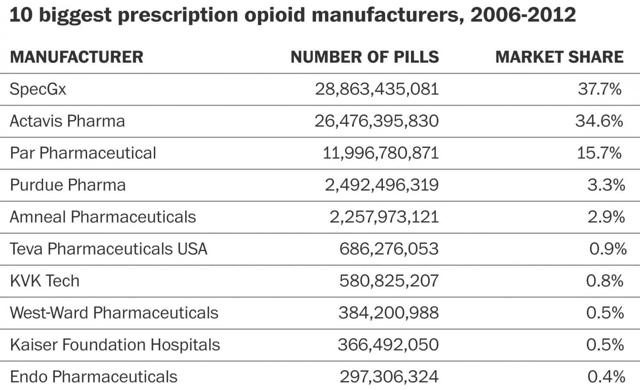
According to the data unearthed by the Post above, nowhere. In fact, Johnson & Johnson’s biggest opioid product, a fentanyl patch called Duragesic, already saw sales tapering off long before the beginning of the epidemic in 2006. The sales numbers for Duragesic, taken from annual reports, are as follows:
- 2004 - $2.08B
- 2005 - $1.59B
- 2006 – $1.3B
- 2007 - $1.16B
- 2008 - $1.04B
- 2009 - $888M
Nucynta has a much smaller market. Assertio Pharmaceuticals (ASRT) acquired the rights to it in 2015 for $1.05B and sold $190M worth from April to December that year (page 5). Sales figures for the years prior when it was owned by Johnson & Johnson subsidiary Janssen Pharmaceuticals are not available in annual reports.
The relatively small numbers here are not stopping the company from being sued by the State of Oklahoma, with prosecutors hyperbolically calling it the “Kingpin” of the opioid epidemic to boot. State Attorney Brad Beckworth put this in no uncertain terms:
"What we do have in Cleveland County is 135 prescription opioids for every adult. Those didn't get here from drug cartels. They got here from one cartel: the pharmaceutical industry cartel. And the kingpin of it all is Johnson & Johnson."
The Post’s infographic which breaks down data from the Drug Enforcement Agency on a county by county basis, puts the number in Cleveland County at 41.1 per person per year between 2006 and 2012. The numbers in these cases are all over the place and there is very little clarity. Who is responsible for what goes beyond companies. It includes doctors and the FDA itself.


